For many people, the search for a business like this does not begin with numbers. It begins with a shift.
A moment where what you are doing no longer feels like enough. A realization that you want more control over your time, more connection to your community, and more meaning in the work you are building every day.
That is often what leads people to explore kid-friendly franchises.
But once you start looking, the options can feel overwhelming. There are childcare centers, enrichment programs, indoor play concepts, and retail brands, all positioned as strong opportunities. Some feel exciting at first glance. Others seem complicated before you even get started.
And somewhere in the middle of all of it, a more important question begins to take shape.
Not just what exists, but what actually works long term.
Why Kid-Focused Businesses Continue to Grow
The demand for businesses centered around children has not just grown. It has become more intentional.
Families today are selective about how they spend both time and money. They are looking for experiences that feel safe, enriching, and worth repeating. That shift has quietly changed what success looks like in this category.
The strongest businesses are no longer built on volume alone. They are built on trust, consistency, and the kind of experience that keeps families coming back. When those elements are in place, growth becomes more natural. Customers return. They bring friends. They talk about it in their communities.
Over time, that kind of behavior creates something far more stable than one-time traffic ever could.
The Decision Behind the Decision
Most people begin their search by focusing on the practical questions. What does it cost? How quickly can you open? How difficult is it to operate?
Those questions matter, and they should be part of the decision.
But they are not what determines whether a business lasts.
The deeper decision is whether you are building something families return to or something they visit once and move on from. That difference may not be obvious in the early stages, but over time it shapes everything. It influences revenue, predictability, staffing, and ultimately the role you play as an owner.
What to Look for in a Kid-Friendly Franchise
The most successful concepts tend to feel simple on the surface, but they are built on thoughtful structure underneath.
There is a clear experience for the child, but just as importantly, there is a clear value for the parent. The model is not dependent on constant owner involvement, and the operations are designed in a way that can be repeated and scaled.
As you evaluate different opportunities, it helps to look beyond the brand and into how the business actually functions day to day. Does it feel manageable? Is there a system in place to support you? Can you realistically grow beyond a single location?
The answers to those questions tend to matter far more than the initial impression.
Understanding the Different Types of Kids Franchises
There are several paths within this space, and each one comes with its own set of expectations.
Childcare and early education franchises are often the most established. They offer consistent demand and long-term stability, but they also require significant investment, licensing, and operational oversight. For some owners, that structure is reassuring. For others, it can feel like a barrier.
Enrichment programs, such as tutoring or STEM-based learning, offer more flexibility and often operate in smaller footprints. These businesses can scale, but they rely heavily on programming quality and staffing consistency.
Indoor play and experience-based concepts have grown rapidly in recent years. Within this category, there is a clear distinction between high-volume play centers and more thoughtfully designed experiences. That distinction matters, because it directly impacts whether families return.
Retail concepts, while sometimes simpler to operate, often depend on location, inventory, and seasonal demand in ways that can make long-term growth less predictable.
Where Many Concepts Begin to Break Down
As the category expands, many brands focus on making their model as accessible as possible. They emphasize speed, simplicity, and ease of entry.
While that can be appealing at the beginning, it often creates challenges later.
When the experience is not memorable, families may visit once but have little reason to return. Without repeat visits, growth becomes inconsistent, and the business begins to rely on constant new traffic just to maintain momentum.
Over time, that model becomes harder to sustain.
A More Intentional Approach to Kids Franchising
Play Street Museum was created with a different perspective.
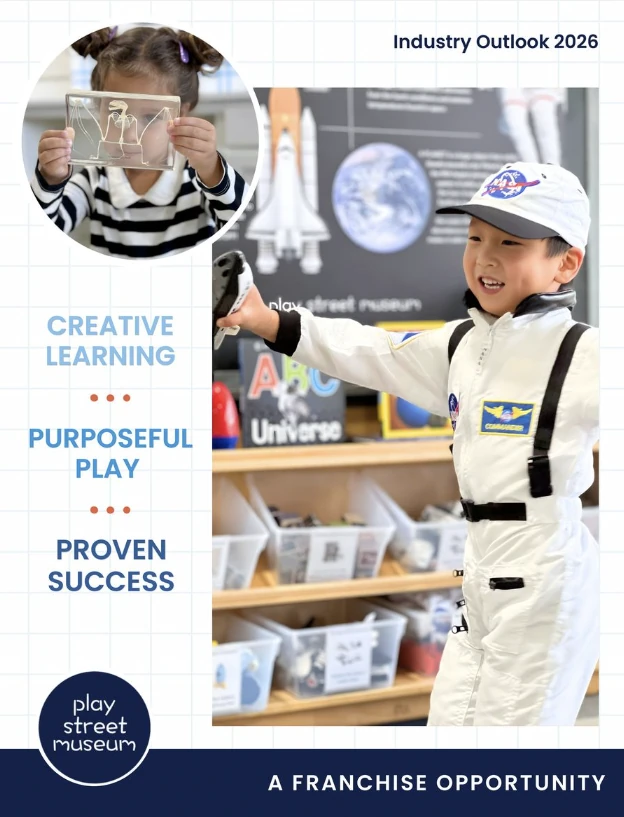
Instead of building around volume, the early childhood education franchise concept is built around experience. Each location is intentionally designed to feel calm, curated, and welcoming. The environment encourages children to explore through purposeful play while giving parents a space where they feel comfortable staying, engaging, and returning.
This approach may seem subtle at first, but it has a meaningful impact on how the business performs. Families do not just visit. They come back. They build routines around it. They recommend it to others.
And over time, that consistency becomes the foundation of the business.
How the Model Works Day to Day
From the outside, it looks like a children’s play space. Inside, it operates with a level of structure that creates stability for both customers and owners.
Rather than relying on unpredictable foot traffic, Play Street Museum locations are built around scheduled play sessions, private parties, special events, and upscale retail and crafts. This creates a rhythm to the day and allows owners to plan capacity, staffing, and customer flow in a way that feels controlled.
That structure changes the experience of ownership. Instead of reacting to constant variability, you are managing a business with a clear cadence and predictable patterns.
Investment and What It Takes to Get Started
Opening a Play Street Museum location is a meaningful investment, and it is important to approach it with clarity.
Based on the Franchise Disclosure Document, the estimated initial investment typically ranges from approximately $482,000 to $759,000, depending on the market and buildout requirements. Prospective owners generally need around $150,000 in liquid capital and a net worth of about $700,000.
Compared to larger childcare models, this creates a more approachable entry point while still supporting a premium, experience-driven concept.
Support That Carries Beyond Opening
Starting a business is rarely about the idea alone. It is about everything that comes after.
Site selection, construction, hiring, marketing, and daily operations all play a role in how the business performs. Without guidance, those pieces can feel overwhelming.
With Play Street Museum, the franchise process is designed to feel guided rather than uncertain. Franchise owners receive structured onboarding, several weeks of training, on-site opening support, and ongoing operational and marketing assistance.
There are also corporate-owned locations that continue to refine systems and processes, allowing franchisees to benefit from ongoing improvements.
That level of support makes a difference in how confidently you can move forward.
Built for Growth Beyond the First Location
Opening a business is one milestone. Growing it is another.
Because the Play Street model is designed to be efficient, structured, and repeatable, it creates an opportunity for expansion over time. Many owners begin with one location but have the ability to grow into multiple units as they become more comfortable with the model.
That scalability is part of what makes the opportunity appealing from both a lifestyle and long-term financial perspective.
The Part You Cannot Measure on Paper
There is also something about this type of business that does not show up in the numbers.
You begin to recognize the families who come in each week. You watch children grow, celebrate milestones, and build memories in a space you created. You become part of your community in a way that feels real and lasting.
For many owners, that connection becomes one of the most meaningful parts of the business.
Is This the Right Fit for You?
Not every business is the right fit for every person.
But this category tends to resonate with those who are looking for something more than just an income stream. It attracts people who value connection, consistency, and the ability to build something that serves both their family and their community.
You do not need a background in education or childcare to get started. What matters more is your willingness to follow a proven system and your commitment to creating a positive experience for the families you serve.
Where Family-Focused Businesses Become Something Bigger
There are many kid-friendly franchise opportunities available today, but not all of them are built to last.
The ones that continue to grow tend to share a common thread. They are intentional in how they operate, thoughtful in the experience they create, and designed for people to return again and again.
That is what transforms a business from something people try into something they rely on.
And for the right owner, that is where the opportunity becomes something bigger.
If you are looking for a business that offers both structure and meaning, it’s time to explore what Play Street Museum can offer.
FAQs
What is the best kid-friendly franchise to own?
The best option depends on your goals, but many entrepreneurs prioritize models that offer repeat visits, strong support, and community engagement.
How much does it cost to open a kids franchise?
The total investment to open a Play Street Museum typically falls between $482,000 and $759,000, depending on your location and buildout.
Do I need experience to open a kids franchise?
No. Many kid-focused franchises are designed for first-time owners and provide structured training and support.
What makes a kids franchise successful?
Long-term success often comes from repeat customers, strong experiences, and a model that is designed for consistency and growth.